Sunday, November 28, 2010

Review: Kin, Royal Court

Written for Culture Wars

Those prone to cynicism might suggest that, by tackling the rancorous trappings of an all-girls boarding school, E.V. Crowe had her heart set on a Royal Court debut. Both the setting and its brazen handling, which includes some vicious bullying and some mild lesbianism, are so obviously in line with Dominic Cooke’s manifesto against the middle-classes that it must have set the Court’s literary department salivating. That her foul-mouthed, sexualized protagonists – angry young schoolgirls both – are only ten years old seems deliberately affronting, as if she’s trying to trump the troubled teens of Polly Stenham and Anya Reiss.

It’s not that there’s anything particularly wrong with Kin. It’s just that there’s nothing particularly righteous about it. Crowe’s play seems concocted less out of any campaigning spirit than the desire to enhance the playwright’s own standing.

Perhaps it is churlish to scuff the polish of the Court’s recent success, but one can’t help but consider the wider implications of the theatre’s voguishness. Might it be affecting the causes being tackled by our playwrights? One can easily imagine the country’s literary agents racking their brains for Court-friendly topics and cooking up a new genre: the Smallbone kitchen-sink drama.

Boarding schools apparently took on record numbers in the wake of the Harry Potter phenomenon. Crowe hogwashes the seduction of Hogwarts. (At one point, the staunch housemistress pointedly deducts five mysterious points.) Instead Crowe presents a hostile environment that, thanks to the unspoken law against squealing, is immune to change. The school’s décor – perfectly captured by the excellent Bunny Christie – is blanched and damp. There is not a flourish of comfort to be seen amidst the swing doors and strip lights.

Roommates Mimi (a slightly precocious Maya Gerber) and Janey (Madison Lygo, superb) sit cross-legged on the their bunkbed and talk like miniature, school-uniformed versions of Pete & Dud. Mimi (take note of those syllables) is the school’s golden girl: bright, well-turned out and recently cast as John Proctor in the school play. Janey is, publicly at least, a bully. Behind the closed doors of the dorm, however, her own insecurities and intimidations come to light.

Crowe’s over-deliberate insertion of The Crucible elevates the school authorities' attempt at pastoral care into a witch hunt. Mrs B, played like a clenched fist by Annette Badland, stomps through the dorms patrolling for evidence of mischief. In an attempt to root out bullying, she prosecutes her girls – whom she describes as “small dogs” and “ferrets” – attempting to extract confessions.

Really, though, Kin is overly reliant on an inverse nostalgia; a fondness not for the glowing delights of youth, but for cruelties overcome. These trials, after all, are what shaped us into our adult forms. They are character-building and we look on them with a warped affection. That Crowe peppers her world with totemic remnants – tuck boxes, metal lockers, the stinging brevity of the phone-call home and, most sentimentally of all, ‘Once in Royal David’s city’ – shows the emotional manipulation at play. For those already set against the boarding school system, there is nothing revelatory to enhance their case.

Aside from our in-built attraction or repulsion, Crowe depends upon the juxtaposition of angelic delights and their foul mouths. It’s the old Royal Court trope of all-too-adult children, as the girls display unexpected cruelty (though the enforced exposing handstand is a canny image) and early-onset sexuality, racing to reach puberty’s finish-line. I suspect director Jeremy Herrin knows as much. He struggles to find any truthfulness within, caught between emphasizing its cartoonish calamities and straightly playing its moments of simple poignancy.

With education so prominent in the news at the moment, the classroom and the playground undoubtedly have a place on our stages. In retreating to the easy divisiveness of the dorm, however, Crowe has missed the matter’s urgency. We shall have to hold out more hope for the forthcoming Schools Season at the Bush.

Photograph: Johan Persson

Friday, November 26, 2010

Review: Gatz, Public Theatre, New York

With just over an hour break for dinner, Gatz – Elevator Repair Service’s exhaustive staged reading of F. Scott Fitzgerald’s The Great Gatsby – rolls in with a runtime of eight hours. More or less the same length, in other words, as your standard nine-to-five working day. During that time, not one of Fitzgerald’s words gets missed out.

To think of Gatsby is to think of the fizz of a thousand champagne saucers. The novel’s world is, at least initially, one of resplendent social butterflies flitting tipsily across lush, expansive lawns. They are carefree creatures, moneyed enough to simply languish in the party of the present moment. Usually, of course, that party is one of Gatsby’s hosting, as the twenties roar with all their might.

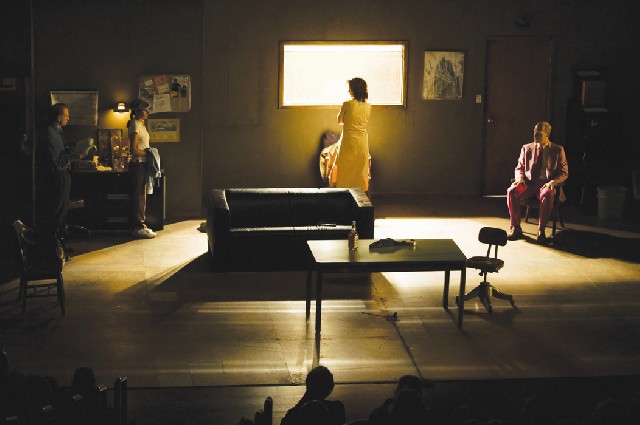
Yet here, Elevator Repair Service, whose similarly all-inclusive reading of The Sun Also Rises headlined this year’s Edinburgh International Festival, place the glitz of Gatsby into a run down office. Its walls are dreary and stained. A leather sofa sits sadly next to a purposeful metal desk, itself laden with stationary and hulking office technology. Filling its shelves is a jumble of jaded files and sagging storage boxes, all presumably stuffed with receipts and tax returns.

The collision of these two seemingly oppositional worlds is massively fruitful. It’s not simply a case of using the physical vocabulary of the workplace to enact the novel, such that coffee mugs stand in for whiskey tumblers and swivel chairs serve as Rolls Royces. Rather the two co-exist. One is built upon the other, such that the dynamics of the office form the structural foundations that underpin those of the novel. Endless partying, non-stop flitting and flapping, you realise, is pretty hard work in itself.

The novel’s narrator, Nick Carraway, materializes slowly in front of us. He is, at first, an anonymous office worker (played by Scott Shepherd), forever restarting his jammed computer, who picks up the book by chance and begins reading aloud. With a strange synchronicity, events around him echo his words: colleagues appear as characters enter, the phone rings just as Fitzgerald orders. Before long – much like the immersive process of reading – Carraway’s tale has taken flight, gaining a momentum that overtakes his daily routine. The office clock has stopped. Time has stood still and become embraceable, much as it did for the bright young things of the post-war generation. Gatsby’s world, as much as the office from which it stems, is the product of a hiatus in which work can wait and life – in all its brevity – can be lived. The normal order of play has been suspended. As Carraway says early on, “I had nothing better to do.”

Beyond the presence – and absence – of labour, the office environment serves to highlight a number of Fitzgerald’s other primary themes, amongst them money (earned both honestly and shadily) and technology. The computers and calculators of the workplace underscore the machine-lust of the twenties: swish cars, aeroplanes and the juicer that “could extract the juice of two hundred oranges in half an hour if a little button was pressed two hundred times by a butler’s thumb.” Where once man was in thrall to the machine, ERS suggest, now he has become entirely – and overly – reliant on it. In fact, one always feels that this retrograde office is a product of that earlier period in American history. Gatsby holds the key to its aspirations. They – we – grind away in order to afford his lifestyle and luxuries. The American Dream has brought about the American Drudge.

Throughout one gets a sense of both Gatsby and, in the terms of formal logic, not-Gatsby. The great man himself, in fact, is a world away from the chiseled, dashing charmer one expects; the one so readily embodied by Robert Redford in Jack Clayton’s 1974 film. (Redford will doubtless be joined in that by Leonardo di Caprio in Baz Luhrmann’s forthcoming screen version.) Gatsby, we imagine, fits into a great line of Hollywood smoothies. He is a Mr Ripley or a Rhett Butler, even a bar-room Bond.

Embodied by Jim Fletcher, however, he becomes a Lurch or a Boo Radley figure. Fletcher is a tall, broad, flat-footed hulk, almost entirely bald. Crammed into, for the most part, a mismatched suit of strawberry ice-cream pink with a chintzy cherry tie, he is far from the gravitational force that sets those about him tailspinning. More often, he seems a shy wallflower, reclusively avoiding his guests rather than leaving them guessing. And yet, there a strange charisma is retained. It’s entirely in keeping with something Milan Kundera drops into his novel Slowness: “People always think that a man’s fortunes are more or less determined by his appearance, by his hair or lack of it. Wrong. It is the voice that decides it all.” And, as Gatsby, Fletcher’s is a magnificent and seductive rumble: deep and soft and paternal, blunt but still penetrating. It is an authoritative purr that commands like a hand on one’s shoulder.

And then, suddenly, the title makes sense. The man Fletcher embodies is not Jay Gatsby but his original: James Gatz. In other words, not the sophisticated, mysterious “Oxford man” that others perceive, but the former army Major, the college dropout, the ex-janitor, the man who passed through Trinity College, Oxford for a matter of weeks. In his charmless, joyless demeanour, one senses the strain, the effort and the monotony behind the façade of his existence as Gatsby.

This disruption of Fitzgerald’s novel stems from ERS’s chosen form, that is, to (dis)honour the novel in its entirety. What quickly becomes apparent is how ill-fitted it is for the stage. It remains a novel and, as such, its whole mode runs counter to the oldest rule of theatre: show don’t tell. Here ERS embrace the faltering process of translation, harnessing the jagged edges that result such that nothing quite meets the demands of the text. Characters that are sketched so concisely and so memorably on the page, with a neat flick of Fitzgerald’s pen, become odd creatures onstage. Their distinguishing features are embodied in one-dimensional facial gurns and physical tics. How, for example, does one stage throwaway remarks such as this: “A tiny gust of powder rose from her bosom.”Rather than the closed system that we usually encounter onstage – whereby guns in the first act go off in the third – we get something more sprawling and unravelled, something that needs chasing. The whole thing feels ungainly. The period charm disappears, though there remains – in the very awkwardness with which the text is handled, such that characters often seem at a loss, racking their brains as the narration steamrolls over them – a disjointed elegance.

Occasionally, ERS push too far and too hard, forcing a crumple out of the collision. For a moment towards the end of Part 1, they seem to have become cynical, stepping outside of the task to mock its crudeness. When a plastic fish and a goggle-eyed thermos (a hangover from a previous work, I believe) emerges for a tea-making ritual, one feels that they have drifted towards spoof and sabotage.

However, by retaining its status as novel and reveling in the clash of forms, ERS are able to reveal a great deal about entertainment. In the impossibility of an unwieldy square peg fitting a tidy round hole, we see both peg and hole, novel and stage, for what they really are. We see their relative merits and failings. One realizes the effort that lies beneath entertainment, the laborious endurance of reading as an activity. Interestingly, one also gets far more of a sense of the writer than usual; Fitzgerald’s phrases seem sculpted subclauses, each word very deliberately plucked from the shelves of his vocabulary.

As it winds down, almost refusing to find the neat, climactic flourish that we expect of theatre – the shot of All My Sons, the marriages of Shakespeare’s comedies – it rolls on and extends, reeling out postscripts for characters, a melancholy mist descends. One longs as much to be released as one does for it to continue onwards, as if there is simultaneously too much already told and yet so much more to tell.

Gatz, looking back, is an astonishing piece of work with a piercing clarity about both its subject and its form. It deserves to affect the practice of its contemporaries and go down in the history books as something seminal. Much like Gatsby himself.


Photograph: Chris Beirens

Friday, November 12, 2010

Review: Suspended, Chelsea Theatre

Written for Culture Wars

Atop a ladder, cloaked in a sheeny black shroud, sits Natasha Davis. Strands of her hair stand out from her scalp, tied to string attached to the ceiling. She looks almost like a shampoo advert frozen mid-swish, but there’s something calmer, more peaceful and meditative about her. She seems entirely natural, almost fantastically so, like a woodland fairytale creature; wise and old and rooted. A half-smile of half-contentment plays across her lips. She is settled. A good job, really, since any rapid movement, any slip from the ladder would tear her hair from its roots.

For all her seeming happiness, then, she is caught. Her lot is one of contentment within constraint. The question is whether to stick or up sticks in search of more, potentially risking the security and serenity of her current position.

The scissors in her hands testify to her decision and, strand by strand, she sets about snipping herself free, at times inviting us to take part in the process as well. She cuts not the string, but the hair itself, just below the knot. Wisps of her hair remain hanging from the ceiling, dangling around our heads in the promenade space. This is a literal uprooting for Davis, who emigrated from her native Croatia before arriving in the UK in 2000, but it involves leaving pieces of herself behind. It is a gorgeous, pensive and clear image, swamped in its own space and time.

From that point on, however, Davis’ work become blurrier and – rare for a performance so grounded in its realities – almost sentimental. She is so intent on making us feel the tangibility and viscerality of her performance that she undermines her intentions, which are less than clear in themselves. Everything is lingered over sumptuously and slowly.

What starts autumnal and rosy, as she stands half-steady on a platform of loose apples and sings, grows colder and harsher. She empties salt into a ritualistic circle on the floor, adding a layer of grass. She wraps herself in a series of protective jackets, fashionable but also armour. She squeezes, in a tiny image of transfixing violence, meat through a mincer so that it bubbles and squeaks with blood.

This is a wrenching. The darkness of Davis’ imagery suggests a tearing of the self, as if, having left part of herself in her homeland, it has been stretched too far and too thin. The process of migration, Davis suggests, undoes a person at the seams. When she hammers three nails through a map of Europe – first Croatia, then Greece, then England – we see the tear. Wherever one goes, there exists a longing for elsewhere. A pull in different directions that works like a rack.

But it ends in peace. Davis, lying flat on the floor beneath the sheeny shroud, inches her way through the crowd, pulling herself along by the movements of her shoulderblades. The artist becomes an oil slick or an incoming tide. Slow and steady, considered and calm – though not without effort – it suggests a coming to terms. Perhaps, in that balance of peace and exertion, movement without discomfort, Davis is suggesting a happy medium. Sure, it is not a full return to the total, still quietude of the first moments, but it is noticeably full of composure and poise. Tumult, Davis suggests, is a necessary process in seeking self-improvement. Suspended seems a call to arms for a happiness more full, if not as satisfied or content.

Tuesday, November 9, 2010

Review: Antarctica, Chelsea Theatre

Written for Culture Wars


Perhaps the last place on earth you’d expect to have its own artist in residence is Antarctica. It is the coldest, windiest, driest and iciest of all the continents; a place so near inhospitable that even the notion of residence there – artist or otherwise – seems inconceivable. The average temperature rests at around -56°C. On it’s coast, wind speeds can hit 198 mph and, of course, for six months of the year, it sees no sunlight whatsoever.

Such obstacles, however, did not deter Chris Dobrowolski from applying for the position with the British Antarctic Survey and, in this chirpy performance lecture, he recounts his time there. Not only does he paint a vivid picture of a lifestyle that seems extraordinary to those of us perched just off the New Kings Road, he grapples with his own isolated position whilst there as the only person of an artistic bent on an entire continent.

Having previously explored unusual forms of transport (previous works include a plane constructed from newspaper and a hovercraft made of recycled bottles), the main thrust of Dobrowolski’s proposal was to build a functioning sledge from picture frames. In addition, Dobrowolski aimed to contrast everyday representations of Antarctic life – particularly assorted toys and knick-knacks – with the realities.

What emerges – apart from some of the most surreal holiday snaps you’ll ever see – is a multifaceted work that interrogates the nature and purpose of art at the same time as embracing the all-sorts it takes to make a world.

Take Dave, the plumber deposited on Bird Island for a two-year stint alone amongst thousands of aggressive, randy fur-seals and a handful of cannibalistic ducks. This is, as Dobrowolski tells it, an ecology in which corpses are consumed, the stench of which (death and excrement) hits you half a mile off-shore. On the plus side, there’s a well-stocked DVD library.

We meet trawlermen and scientists, HR managers and projector enthusiasts and yet – charmingly, optimistically and heartwarmingly – Dobrowolski brings a shared humanity to the fore. Our ability to connect and communicate, to share a joke even when faced with such astounding surroundings and hardships seems phenomenal.

Throughout, Dobrowolski positions himself as amicable failure, nearer Dave Gorman than Kim Noble, and in many ways Antarctica is a celebration of difficulties overcome and attempts failed. It embraces defeat, pointlessness and hapless co-incidence. Imagine schlepping approximately 10,000 miles to build a sledge out of picture frames, for example, only to discover that bored Antarctic engineers pass their time fashioning picture frames out of, you guessed it, dismantled sledges.

Photograph: Chris Dobrowolski

Sunday, November 7, 2010

Review: Almost the Same (Feral Rehearsals for Violent Acts of Culture), Chelsea Theatre

Written for Culture Wars

Hanging from her hands are two skinned hares. The meat of one glimpses through an armour of flecked tin-foil. The other is mummified with cream bandages. Later a pair of white wings are attached to its back, as they hang from meat hooks, swinging in sync. Together they are oddly serene in their state of slow decay despite half-hearted preservation.

This is the level of horror that runs through Julia Bardsley and Andrew Poppy’s latest collaboration. Its ghastly images never explode before you, sending you spiralling in shocked recoil. Rather they are slow-burning terrors that dangle before you, festering away at your sensibilities. The longer you look, the more alarmingly transfixing they appear. With Poppy’s eerie, reverberating soundtrack wearing down any defences, Almost the Same works like a slow-turning corkscrew, mining imperceptibly into your sub-conscious.

From her first appearance, sat illuminated in the stalls writhing lavae-like in a PVC cocoon, Bardsley presents an elusive, puzzling figure. One looks first to discern the image, almost squinting to try and work it out, to make sense by understanding its constituent parts. Later she appears in a faux-fur coat, fishnet mascara and plasticised wig, unnatural in the complete uniformity of its colour. This get up is repeated for each of the three sections, first in brown, then bright red and, finally, white.

Throughout Almost the Same the synthetic is juxtaposed with the natural, the non-biodegradable with the dead and decaying. It is as if a modern – even oddly futuristic – woman has resorted to the wilderness, escaping the expectations of urban domesticity for a primitive existence of totemic rituals.

In all this Bardsley is positioning herself against us. From the moment we step into the space, we are carefully positioned into a triangle. We are regimented. Our formation – a side, rather than a point, faces her – is defensive, even nervy. The one squares up against the many. She has opted out of the socially normative. Perhaps that is why we view her with such horror and trepidation.

And yet, as the title makes clear, that opposition is not across a vast chasm. It is a slight twist that changes everything, throwing it into antithesis. We say hair, she says hare; we say can’t, she says cunt. This creature before us resides within us all. She is not without human traits: there is a tender maternal quality to her treatment of objects and corpses, which sits next to an animal instinct and affinity with the natural environment, the natural order. This is us stripped of the pressures of sanitation and society. That makes Almost the Same all the more achingly terrifying.

Photograph: Manuel Vason

Review: Macbeth, Barbican Pit

Written for Culture Wars

Imagine if you could bath in Macbeth. Or cut it into lines and snort it. What about painting your house Macbeth?

“Ok”, you’re probably thinking, “this time he’s actually lost it. What is he on about?”

What I’m trying to say is that Song of the Goat’s 75-minute Macbeth is about as non-natural – by which I mean ineffable, rather than anti-Stanislavskian – as any piece of theatre I’ve seen. The Polish company treats Shakespeare’s text not in terms of its mechanics and motivations, but as an orchestral score. Using Grotowskian techniques of rhythmic movement and Corsican chanting, they translate it into something uniquely theatrical, something that chimes rather than planting ideas. The result is essence of Macbeth.

The words are treated sensorily. They carry meaning not through the concepts they signify, but on account of their tonal properties. Much of the text is chanted or sung chorally, sometimes delivered in layered whispers such that the words themselves become obscure and invisible. The same is true of the physicality. The eight performers hop and bounce around the stage like Kabaddi professionals, landing with measured weight. They slice the air with wooden staffs swung or thrown between one another; here, slow and gentle; there, fizzing and fierce.

This is a Macbeth that you feel before you follow it. You absorb it without consciously registering what’s going on behind the performance, what it’s signifying. That expressionism makes this Macbeth unfamiliar and counter-intuitive, quite often surprisingly so: you get a sense of the whole without being able to separate its constituent parts. It’s as if the entirety of Shakespeare’s play were contained in the dazzle of a single flashbulb. It’s the theatrical equivalent of Willy Wonka’s Three-Course Dinner Chewing Gum.

Of course, such an approach comes with heavy casualties. Often the plot is difficult to follow and one finds oneself constantly searching for familiar sections to serve as anchors. At times it feels like the edited highlights: those passages that have come to represent the play – “Is this a dagger,” “Out, out damn spot,” Banquo’s assassination and visitation etc – are delivered without the conjunctive momentum. In fact, there are moments when one struggles to decipher what’s going on at all. It took me a good half-hour to locate Banquo amongst the cast, identically dressed in long, starched skirts.

That has the knock on effect that, somewhat dispiritingly, this is not a Macbeth that can offer an interpretation. At this level of enquiry – rational, textual, analytical – one learns nothing new about the play. More than that, one loses the sense of the impending and inevitable, the dark heart of ambition that drives the play and the accompanying guilt.

But to bemoan such losses is akin to knocking a Macbeth for revealing nothing about Hamlet.

Instead, Song of the Goat convert Shakespeare’s play into a whole new format; they present it anew, by allowing us to experience it in a completely alternate mode and manner. It’s almost synaesthetic. And in those terms, it is dazzling. The combination of its movement and sound (beneath the chanting is a constant accompaniment on the Korean kayagum, twanging and pealing) draw you inside the play, rather than observing externally. The overall effect is like a snake charmer: it’s kinesthetic properties go to work on you and its not long before you’re moving along, following each swish with a turn of your head or swaying and spiraling softly in your seat. Like two atonal guitar strings that eventually synchronize, Song of the Goat tune you in to the rhythms, timbres, textures and pitches of Shakespeare’s text.

Words seem to ripple into movement, as if the performers’ bodies are led by their lungs. You breathe along, inhaling Macbeth such that it gets inside you and lingers.

At times, such as when the witches deliver airy, staccato incantations or in the warbled wailings of Lady Macbeth (a frayed and pallid Anna Zubrzycki), it is exceptionally haunting. Elsewhere, it is more earthy and visceral – achieved without any nod to viscera, actual or represented. Gabriel Gawin’s Macbeth is a grounded, solid presence, often oddly graceful in his masculinity, despite never making much of a villain out of the man. Banquo’s assassination, in which he is lashed around the stage by staffs, is stinging and invasive. He flops from one murderer to the next like a rag-doll in heavy winds or tumultuous waves, spinning and flailing. By the time Burnham Wood ups its sticks, the battle is a finely choreographed set of swishes and jumps that leaves you hanging on the edge of a breath. The various staffs come within a whisker of the tumbling performers, but never connect.

That airiness, the delicacy and precision with which Song of the Goat work, lends their Macbeth a tender beauty. One that grips your senses from all directions and holds you in suspense. Not the suspense of a well-told tale, but a physical, felt suspense. It’s a beauty that, without quite knowing why, drew silent tears from my eyes. They had spotted something, even if I couldn’t tell you quite what.

Photograph: Grzegorz Hawalej

Thursday, November 4, 2010

Review: The Quickening of the Wax, Chelsea Theatre

Written for Culture Wars

Only the other day, a friend was explaining their phobia of dummies, manekins and waxworks: inanimate objects with a human form. The more life-like, she explained, the more disturbing. The power of these objects resides in their uncanniness – the feeling that something is not quite right, that it may or may not have subjectivity of its own. In other words, these objects look as if we might analogously expect them to have an autonomous position on the world and, yet, they do not. Uncanniness is therefore increased by realism and resemblance.

Here Marisa Carnesky, in collaboration with underground New York performer Rasp Thorne, explores the power of waxworks and, while she may not pull together a trenchant thesis, The Quickening of the Wax offers a firm survey. It gives you room to pause.

First, she allows us to experience it, drawing her audience into the room in two groups and delivering a chilling jolt. Invited to amble through and examine the onstage objects – waxworks with organs exposed, model hands, feet and fingers, a guillotine – we stumble into a ghost train moment. The lights plunge down, a camera flashes accompanied by a scream. For all its clunkiness, it delivers a chilling intake of breath. Carnesky has made us aware of her hold over us. We know the trap could snap shut at any moment.

And so, as we observe what becomes a lecture-demonstration, we do so in a state of suspense; guarded and susceptible.

The most obvious strand Carnesky draws out is that of death. The guillotine and electric chair – both of which are employed, albeit in pretence – remind us that to stare at a waxwork is to observe one’s own corpse. And yet, like the executions Carnesky enacts, it is marked by its artifice and approximation. The waxwork is insincere: quite literally, not without wax.

Sweeping through Carnesky flags the dualism inherent in the waxwork, that we fear existence – or the lack thereof – without the body, but also the ache of a body stripped of purpose. As her wax models, two of which are supplemented by an actor’s own body parts poking through holes, writhe and groan, they seem oddly trapped. The body is unable to move, its various parts – organs and limbs – have stiffened and solidified. The prison of paralysis becomes clear.

Or perhaps the effect is the other way around, the inanimate object made animate and the warped fantasy of resurrection. For its final pithy image, Carnesky brings a cleaner onstage, vacuuming around the creaking, observant bodies before freezing herself. Its at once a slow winding down, gliding softly back to the mundane, and a witty flip of perspective.

There is too much breadth in Carnesky’s piece, which seems both scatty and measured in its structure - a rolling miscellany of points - but her content is fascinating. She smartly suggests the –philia that runs counter to the –phobia, exploring the angelic serenity of the waxen face, Snow White sweet and still. She explores the making process and its materiality, the ritual and the objectification of persons. And while that brings about a pensive whole, Carnesky doesn’t quite pull it tightly together. She can’t find the twist to tighten the corset and transform the subject. Intriguing and interesting, then, but The Quickening of The Wax never casts its matter in a new light.

Tuesday, November 2, 2010

Review: Blasted, Lyric Hammersmith

“Reviled. Respected. Revived.” That’s how the Lyric Hammersmith is tagging its production of Sarah Kane’s controversial debut play, notoriously the subject of frenzied media outrage on its first outing at the Royal Court. Given Blasted’s baggage, Sean Holmes decision to program it is a bold one, but not – as some have suggested – a brave one. Whether savvy or cynical, however, I’m still undecided.

Certainly there’s a case for it. Fifteen years is long enough for a new generation of audiences to have emerged – despite the Royal Court’s own restaging in 2000 and Thomas Ostermeier’s Schaubuhne production imported by the Barbican in 2006 – and it is a text that leaves you craving to experience it. And yet – in keeping with last year’s revival of Comedians – there is something uneasy about it’s programming, about the way it guarantees bums-on-seats and media attention. I can’t shake the idea that Holmes might be intent on making his presence – and that of the Lyric more generally – known.

I suppose what I’m saying is that Blasted has become fossilized. We arrive prepared, braced. We already know of its horrors: anal rape, eyeball extraction and cannibalism. We turn up to take up its challenge, to see if we can stand it. As I was leaving, I overheard a female voice boast of having “thrown up a little in my mouth.” That, I think you’ll agree, is absolutely not the spirit of the piece. That’s to take it as a game of chicken. Atrocity bingo. That is to turn up to tuck in to the “feast of filth” that The Daily Mail’s Jack Tinker spoke of in 95.

Back then, John Peter defended Blasted in The Sunday Times, writing, “Theatre is only alive if it is kicking.” Holmes’ production delivers a firm nudge under the table, but it doesn’t really unleash the full force. In fact, it seems rather palatable. There’s a warped grace and a hollow beauty. It’s almost entrancing, addictive even, but it doesn’t really slap you around until you’re forced to admit humanity’s horrifying potential. His production is, more often, quite sympathetic and often calmly rational.

Largely, I suspect, that has to do with Paul Wills’ design, which – in conjunction with Paule Constable’s lighting – lends the whole the timbre of a graphic novel. In the first half, Wills’ gives us a widescreen set, shallow and elongated. His glossy hotel room, gossamer curtains wisping against the back wall, is a palette of off-whites and pastel greys. It feels funereal, even to the point of resembling an oversized coffin. The drowsy, warm morning light that floods in through the windows catches the edges of its characters, throwing them into soft silhouette.

But Wills’ mistake is to all but obliterate that world with the bomb that blasts the play apart half-way through. When the third scene is revealed, all that is left of the hotel is the vast frame of its concrete skeleton. It looms high above, like an echoing, dusty cathedral. Suddenly, this is the void. It’s purgatory. It’s the non-place of Beckett. It is a stage.

And that scuppers the play’s potential to really horrify. Kane’s play exists in the collision of two worlds we thought distinct – one inner-city Leeds, the other a war-torn elsewhere. The first, charting Ian’s callous manipulation, abuse and domination of Cate, contains the seeds of the second, with all its inhuman atrocities. Its violence must burst into a world that feels familiar. The war-zone must come to Leeds.

The near-total obliteration of the hotel, however, removes the concrete reality of the second half’s violence. They are too easily witnessed as metaphor, rather than as continuation. Wills’ design lets us off the hook by denying Kane’s text its own inner-logic.

But all this feels unfairly negative given a text that somehow contains its own impossibility. Though he may not capture the raw, guttural energy of Blasted, its animal savagery, Holmes delivers a brilliantly detailed staging that grips like a vice.

What he does find, particularly in the stunning first half, is the humanity, often cold and rational. Danny Webb’s Ian seems to tactically assess the changing situation, applying a touch more pressure onto Cate, retreating and trying a different tack. Cate’s laughter at his initial clumsy attempt at seduction, stripping unseen and announcing himself with a flourish, wounds him and that wound, you feel, drives him on. From thereon in, for all the traces of fondness between them, they are at crossed purposes: when one jokes, the other is po-faced. Neither can comfort the other: when Ian attempts a genuinely tender hug the next morning, his rasping lung splutters into action, delivering a coughing fit into her ear.

Webb gives a fantastically nuanced turn as Ian. For the most part he’s gnarled, even his attempts at gentle whispers come out with a croaking edge. At one moment, sat on the bed with Cate bathing next door, he manages to seem a soft, harmless creature, almost a Wethers Original grandpa, deflated and waiting, passing time with half-thoughts. Lydia Wilson is more streetwise than one might expect as Cate. She inserts the stuttering insecurities carefully without tipping Cate into the territory of vulnerable fuck-up. Instead, she seems young and, by the end – walking through the detritus, babe in arms – dishevelled, thin and somehow older. As the soldier that intrudes, Aidan Kelly is suitably sizable, but somehow too steady. He towers over Webb’s Ian, but one never feels the unpredictable threat.

And that runs through the entire production. In paying so much attention to the motivations and build-ups, Holmes denies the horrors an animal, ravishing quality. Its telling that the most head-turning of moments comes at the end of the second act, just after the soldier’s entry. Kelly kneels, sliding out a tray with two cooked breakfasts and starts eating. He tears through sausages, scoops handfuls of scrambled egg and fills his cheeks. It goes on for ages, sniper rifle always trained on Ian, and Kelly never slows down in his gorging. In that moment alone – though the torturous and sexual acts demand it as well – does this Blasted gain an unstoppable momentum, acting on its base urges and cravings without thinking and fulfilling a bodily need because it has no choice.

I suspect, given that even after his final, lonely shit Webb’s Ian wipes, Holmes has set out to expose traces of human dignity and survival. It’s just that Kane’s text demands otherwise. It needs disgust and deprivation. It must act on impulse with consequences forgotten. It must lash out and lose control. Only then can it hang its head in human shame.

Photograph: Simon Kane